

If you own shares or equity mutual funds, a single number decides how much of your profit you keep: 12.5%. That is today’s long-term capital gains (LTCG) tax, and this week reports say the government is weighing an LTCG tax cut ahead of Budget 2027-28.
Before you rush to sell, wait, or redeem anything, it helps to know exactly how the tax works now, what is actually on the table, and which moves make sense whatever the Budget decides. Here’s the plain-English version.
Quick answer
- Is there an LTCG tax cut? Not yet. The Indian Express, Moneycontrol and Business Today report that the Centre is discussing it. No decision has been announced, and sources say it could come in the Union Budget 2027-28.
- What is the LTCG tax rate today? 12.5% on gains above ₹1.25 lakh a year from listed shares and equity mutual funds held for more than 12 months, without indexation.
- Short-term gains? Sell within 12 months and the whole gain is taxed at 20% (STCG).
- What should you do? Nothing drastic. Follow today’s rules, use your ₹1.25 lakh exemption every year, and don’t make big moves based on reports.
LTCG tax cut news: what the government is considering
On 26 October, The Indian Express reported that discussions in the run-up to Budget 2027-28 include lowering the 12.5% LTCG rate for both Indian and foreign investors. A second idea is to let foreign portfolio investors (FPIs) pay tax on their gains measured in dollars rather than rupees. A senior official told the paper, “We are discussing every option.”
CNBC-TV18, citing Moneycontrol, added that the Centre has held meetings with industry, SEBI, the CBDT and banks, and is comparing India’s rate with major economies. On 27 October, Business Today reported that SEBI had made a presentation to the finance ministry and that a decision could come in the Budget. Separately, SBI’s Ecowrap report of 12 October suggested scrapping LTCG on equity altogether and asking investors to hold for two to three years instead.
All three are proposals, not law. Finance Minister Nirmala Sitharaman has called the debate “healthy” but, speaking on 13 October, declined to say what she will or will not consider. Follow the story on our trending news explainers page as it develops.
Why the rethink now?
Three pressures are coming together:
- Foreign money is leaving. FPIs have pulled about ₹3.1 lakh crore out of Indian equities so far in 2026, versus ₹1.7 lakh crore in all of 2025 (CDSL data cited by CNBC-TV18).
- Flat markets. Officials told The Indian Express that two years of zero returns or losses, plus weak wage growth, are hurting the mood of middle-class investors.
- Tax competition. Foreign investors point to China, Indonesia and Brazil, which charge little or nothing on such gains. Business Today notes Taiwan levies no LTCG but charges a 0.3% transaction tax instead.
The rupee issue matters to foreign investors too: if Indian shares rise 10% in rupees but the rupee falls 10% against the dollar, the investor earns nothing in dollars yet still owes tax on the rupee gain. When markets move this much, everyday assets swing too, as we saw with the sharp fall in silver prices this month.

LTCG tax rate today: how it works on shares and mutual funds
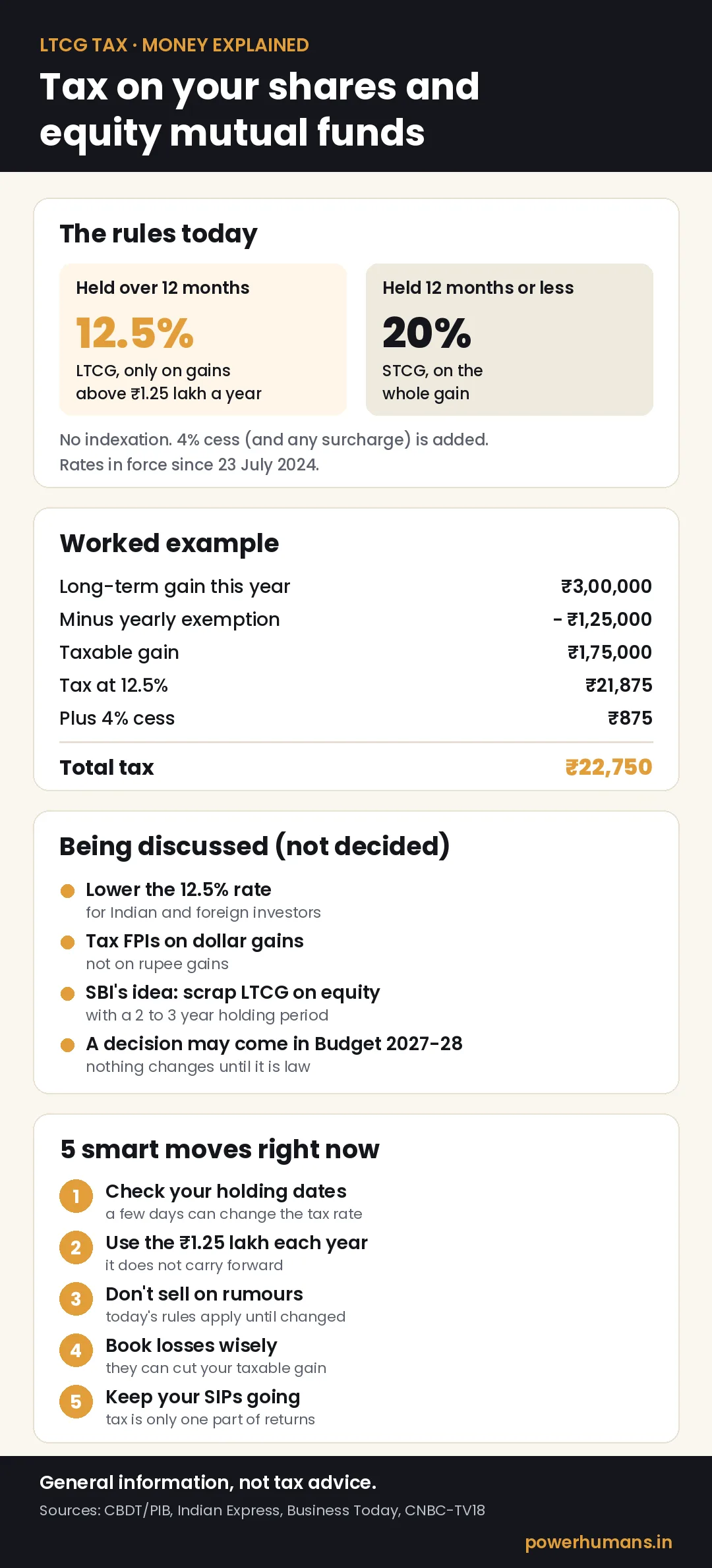
The current rules took effect on 23 July 2024, after the Union Budget 2024-25, according to the CBDT’s FAQs. Here is what applies to listed shares and equity-oriented mutual funds on which securities transaction tax (STT) is paid:
- Held for more than 12 months: the profit is a long-term capital gain. The first ₹1.25 lakh of total LTCG in a financial year is tax-free. Anything above it is taxed at 12.5%.
- Held for 12 months or less: the profit is a short-term capital gain (STCG), taxed at 20% with no exemption.
- No indexation: you cannot adjust your purchase price for inflation on these assets.
- Cess and surcharge: a 4% health and education cess is added to the tax, plus surcharge if your income is high.
Before July 2024, the rates were 10% (LTCG) and 15% (STCG), and the exemption was ₹1 lakh.
LTCG exemption limit: a worked example
Say you sold mutual fund units this year and made a long-term profit of ₹3,00,000. Here’s the tax under today’s rules:
- Exempt: ₹1,25,000
- Taxable: ₹1,75,000
- Tax at 12.5%: ₹21,875
- Plus 4% cess: ₹875
- Total: ₹22,750 (before any surcharge)
If the rate were cut, your saving would depend on the new rate, which nobody knows yet. That’s why it’s risky to plan around a number that doesn’t exist.
Long term capital gains tax on mutual funds: which funds count?
The 12.5% rule above is for equity-oriented funds. Other funds follow different rules, and gold and silver have their own holding periods, as our guide to digital gold, gold ETFs and jewellery explains. Your fund’s factsheet or your capital gains statement from the registrar will show how each fund is treated.
What an LTCG tax cut could mean for you
For most small investors, the honest answer is: less than the headlines suggest. If your yearly long-term gains stay under ₹1.25 lakh, you already pay no LTCG tax, so a rate cut changes little for you directly. Investors with larger gains would benefit most from a lower rate.
The bigger effect could be indirect. If lower tax brings foreign money back, it may support share prices, which helps every SIP investor. But that is a hope, not a promise, and markets react to many things beyond tax. Keep the wider picture in view, like the AI investment boom covered in our story on India’s largest NVIDIA AI factory deal.
5 smart moves to make now, whatever the Budget decides
- Check your holding dates. Selling a few days before the 12-month mark can turn a 12.5% tax into a 20% tax on the whole gain. Look at your purchase dates in your demat or fund statement first.
- Use tax harvesting every year. The ₹1.25 lakh exemption doesn’t carry forward. Many investors sell units with long-term gains up to that limit and reinvest, which resets their purchase price higher. Count exit loads, brokerage and STT before you do this.
- Don’t sell or hold on rumours. Today’s rates apply to any sale you make today. Waiting for a cut that may never come, or come with new conditions such as a longer holding period, could backfire.
- Use your losses. Under the income tax rules, short-term capital losses can be set off against short-term or long-term gains, while long-term losses can be set off only against long-term gains. Unused losses can be carried forward for up to eight years if you file your return on time.
- Keep your SIPs and basics on track. Tax is only one part of your return. An emergency fund and a steady saving habit matter more. Small wins, like trimming your grocery bill, free up money for investing without any market risk.

Common mistakes to avoid
- Forgetting the exemption is shared. The ₹1.25 lakh applies to your total long-term gains from shares and equity funds combined, not to each fund.
- Ignoring short-term gains. STCG at 20% has no ₹1.25 lakh relief, so frequent switching can cost more than you think.
- Skipping the numbers. Before any big money decision, from a foreign degree (see this ₹50 lakh Canada degree reality check) to redeeming a fund, write down the real after-tax amount.
For more practical money explainers, browse our business and money section.
This article is general information, not tax or investment advice. Tax rules depend on your income and situation and can change in the Budget. Please consult a qualified chartered accountant or SEBI-registered investment adviser before acting.
FAQ
Has the government announced an LTCG tax cut?
No. As of 27 October 2026, reports say the Centre is discussing a lower rate and other options, and a decision could come in the Union Budget 2027-28. Nothing has been announced or passed into law.
What is the LTCG tax rate on shares and equity mutual funds?
12.5% on long-term gains above ₹1.25 lakh in a financial year, for listed shares and equity-oriented funds held for more than 12 months. Cess (and surcharge, if applicable) is added.
What is the STCG tax rate?
Short-term gains on listed shares and equity funds held for 12 months or less are taxed at 20%, with no exemption limit.
Should I wait for the Budget before selling my shares?
Only sell when it suits your goals. Today’s rules apply until changed, and any new rules could come with conditions. If you need the money or want to rebalance, the tax saving from waiting is uncertain.
The takeaway
An LTCG tax cut is being discussed, not decided. Until the Budget, the rule is simple: 12.5% on long-term gains above ₹1.25 lakh, and 20% on short-term gains. Track your holding dates, use your yearly exemption, and let your plan, not the headlines, decide when you sell.
Related reads
- Why silver price is falling, and should you buy silver now?
- The hidden costs of jewellery, digital gold and gold ETFs
- 25 ways to make money online and offline
Sources
- The Indian Express: Centre may cut capital gains levy from current 12.5% (26 Oct 2026)
- CNBC-TV18: India weighs LTCG tax cut, dollar-based taxation for FPIs (26 Oct 2026)
- Business Today: Finance ministry weighs options on LTCG tax (27 Oct 2026)
- Moneycontrol: Centre examining proposals to review LTCG tax on equities (13 Oct 2026)
- PIB: CBDT FAQs on the new capital gains tax regime (24 Jul 2024)
- Income Tax Department: Tax on long-term capital gains (tutorial)





Leave a Reply