

Here’s a number that might surprise you: in just one year up to September 2026, Indians bought ₹30,757 crore of “digital gold” through UPI apps, according to NPCI data cited by The New Indian Express. That’s a lot of tiny gold purchases made with a few taps.
And with Dhanteras falling on Friday, 6 November 2026, millions of us are about to buy gold again. Before you do, here’s the part nobody shouts about in the ads: every way of buying gold comes with its own hidden costs, rules and risks.
Quick answer
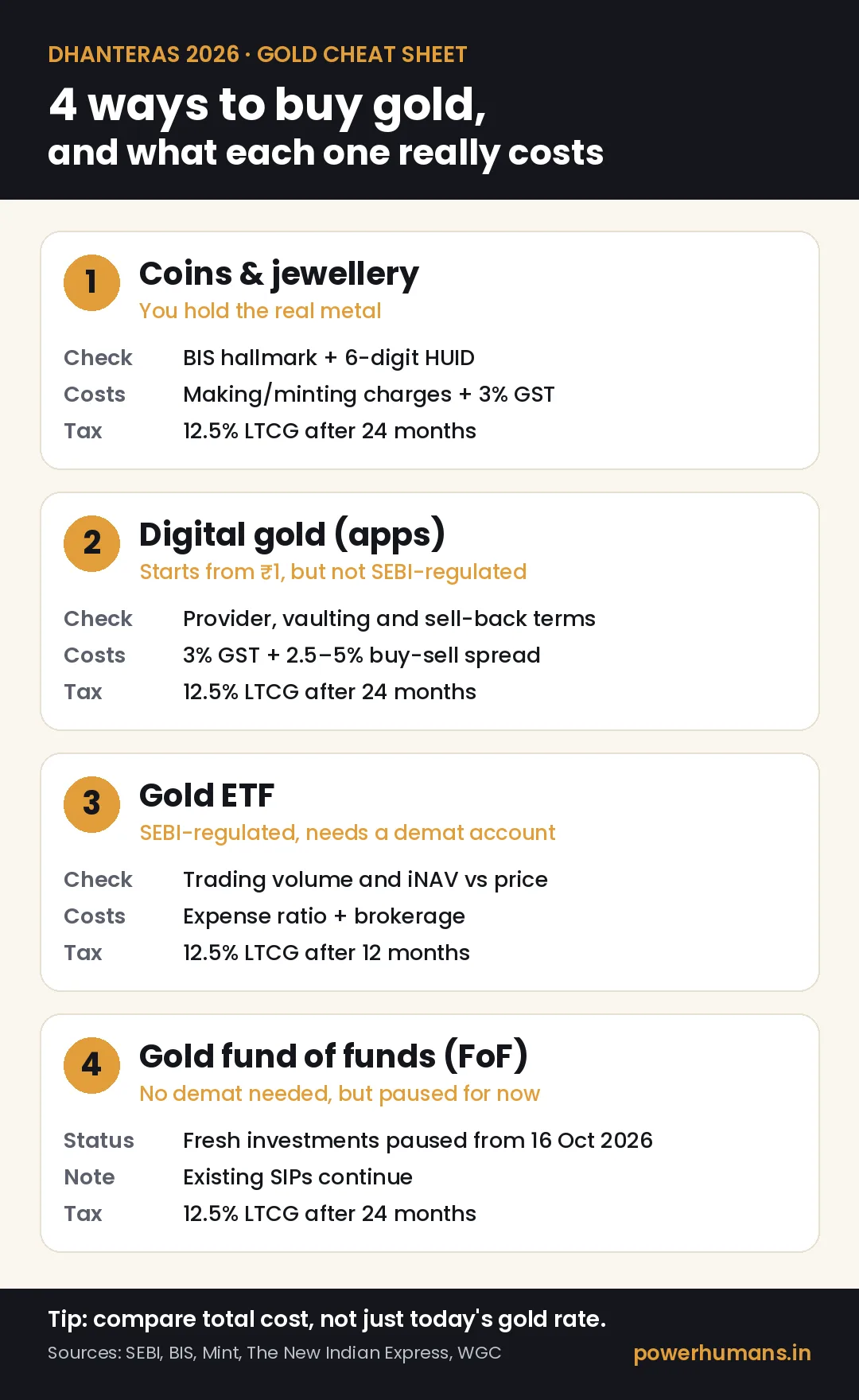
- Jewellery and coins: buy only BIS-hallmarked pieces and check the 6-digit HUID in the free BIS Care app.
- Digital gold: easy and starts from ₹1, but SEBI says it is not regulated by SEBI. You also pay 3% GST plus a buy-sell spread of about 2.5–5%.
- Gold ETFs: SEBI-regulated and still open for buying, but you need a demat account.
- Gold mutual funds (FoFs): fresh investments have been temporarily suspended since 16 October 2026; existing SIPs continue.
Why buying gold feels a little different this year
Two things changed the gold conversation in India this festive season.
First, on 16 October 2026, mutual funds temporarily stopped accepting fresh lump-sum investments, new SIPs and STPs into gold ETF fund of funds, following discussions with the market regulator SEBI, Mint and the World Gold Council (WGC) reported. The WGC says the move is likely aimed at lowering gold imports. Existing SIPs and redemptions are not affected, and gold ETFs themselves are still open.
Second, prices have been jumpy. The WGC noted that domestic gold prices fell about 7% in September 2026, and many investors treated that dip as a chance to buy: gold ETFs saw net inflows of about ₹4,450 crore that month, the highest in seven months, and added 140,231 new investor accounts (folios).
So, more people are buying, the options have shifted, and the small print matters more than ever. If you like these practical money explainers, you’ll find more in our Business section.

Option 1: Jewellery, coins and bars
This is the classic Dhanteras purchase, and it’s the only one where you actually hold the metal in your hand. But there are two hidden costs: making or minting charges (usually lower on coins and bars than on jewellery, Mint notes) and the gap between the price you pay and the price you get when you sell later, plus any locker or insurance costs.
How to check if your gold is genuine, in 2 minutes
- Look for three marks. Since 1 July 2021, hallmarked gold jewellery carries the BIS Standard Mark, the purity (for example 22K916), and a 6-digit alphanumeric code called the HUID, according to the Bureau of Indian Standards (BIS).
- Verify the HUID. Install the free BIS Care app, open “Verify HUID” and type in the code. It shows details such as the jeweller’s registration, the type of article and its purity.
- Use the shop’s tools. BIS guidelines say registered jewellers should keep a 10X magnifying glass and a weighing balance at the counter. Ask to use them.
- Keep the bill. Gold jewellery is billed with 3% GST. A proper invoice showing the weight, purity and charges makes resale and disputes much easier.
Mandatory hallmarking now covers 392 districts, as per the BIS update of October 2026, so ask questions if a jeweller can’t show you a HUID.

Option 2: Digital gold on payment apps
Digital gold lets you buy 24-carat gold from as little as ₹1 on apps like Google Pay, PhonePe and Paytm. The seller is supposed to buy matching physical gold and store it in an insured vault for you. Behind most apps are three main suppliers: MMTC-PAMP, SafeGold and Augmont.
It’s super convenient. But here’s what the ads don’t put in big letters:
- It isn’t SEBI-regulated. In a press release on 8 November 2025, SEBI said digital gold products are “neither notified as securities nor regulated as commodity derivatives” and that none of the securities market’s investor protection mechanisms apply to them.
- The costs add up. You pay 3% GST on every purchase, which you don’t get back when you sell. On top of that, the gap between buying and selling prices is typically 2.5% to 5%. Converting to coins also adds minting and delivery charges.
Here’s what that means in real money: if you spend ₹10,000, roughly ₹291 of it goes to GST, so you get about ₹9,709 worth of gold. Add a spread of a few percent, and gold prices need to rise noticeably before you’re back to ₹10,000.
Option 3: Gold ETFs
A gold ETF is a fund that holds gold and trades on the stock exchange like a share. It’s regulated by SEBI, the fund house takes care of storage, and you can buy small amounts. The catch: you need a demat and trading account, and you pay the fund’s expense ratio plus brokerage.
Two smart checks from Mint before you hit “buy”:
- Don’t compare unit prices. Different ETFs represent different amounts of gold per unit, so a “cheaper” unit isn’t necessarily a better deal.
- Check liquidity and iNAV. A thinly traded ETF can trade above or below the value of the gold it holds. Compare the market price with the indicative NAV (iNAV) shown by the fund house or exchange.
Just like you’d compare the price per kilo when you save money on groceries, compare the total cost per gram of gold, not the sticker price.
Option 4: Gold funds, SGBs and EGRs
Gold fund of funds invest in gold ETFs and don’t need a demat account, but they add an extra layer of costs, and fresh money is temporarily not being accepted (existing SIPs continue). Check your fund house’s latest notice before planning anything.
Sovereign Gold Bonds (SGBs) pay 2.5% a year on the original investment, but the government has stopped fresh issues, Mint notes. You can only buy older bonds on the stock exchange, where you must check the remaining tenure, liquidity and price.
Electronic Gold Receipts (EGRs) are SEBI-regulated, represent physical gold held in accredited vaults, and trade on exchanges. Ask your broker whether they offer them and whether there’s enough trading.
Don’t forget the tax
- Physical and digital gold: sold within 24 months, gains are added to your income and taxed at your slab rate. Held longer, they’re taxed at 12.5% (plus cess), without indexation.
- Gold ETFs: held for more than 12 months, gains are taxed at 12.5% as long-term capital gains.
- Gold FoFs: follow the 24-month holding period.
Tax rules can change, so check the latest rules or talk to a tax professional before a big purchase.
A simple 5-step plan for this Dhanteras
- Decide why you’re buying. A gift or tradition? Jewellery or a coin makes sense. Long-term savings? A regulated option like an ETF may be cleaner.
- Set a budget first. Festive offers are designed to make you spend more. Big money decisions, like the family in our story on a ₹50 lakh Canada degree, show why the full cost matters.
- Compare the total cost. Add making charges, GST, spreads, brokerage and expense ratios.
- Verify everything. HUID for jewellery, provider and sell-back terms for digital gold, liquidity for ETFs.
- Don’t put all your money in gold. Gold doesn’t guarantee returns and its price can swing sharply. If you want to grow your income too, browse our ways to make money online and offline and the Earn Money Online section.
FAQ
When is Dhanteras in 2026?
Dhanteras is on Friday, 6 November 2026 (The Economic Times, citing Drik Panchang), and Diwali (Lakshmi Puja) follows on Sunday, 8 November 2026.
Is digital gold safe?
The big providers are well known, but SEBI has warned that digital gold sits outside its regulation, so you depend on the provider’s vaulting and audit arrangements, with limited recourse if something goes wrong. Keep amounts small and read the terms.
Can I still invest in gold ETFs?
Yes. The suspension from 16 October 2026 applies to gold fund of funds, not to gold ETFs bought directly on the exchange through a demat account.
How do I check my jewellery’s hallmark?
Find the 6-digit HUID engraved on the piece and enter it in the BIS Care app’s “Verify HUID” feature. Older jewellery hallmarked before July 2021 may not have a HUID.
The takeaway
Buying gold on Dhanteras is a lovely tradition, and it can be a smart one too. The trick is to look beyond today’s gold rate: check the hallmark, count every charge, and choose a regulated option when you’re investing rather than gifting. For more timely explainers, keep an eye on our Trending page.
This article is for general information only and isn’t financial or tax advice. Please speak to a SEBI-registered adviser or a tax professional before making investment decisions.
Related reads
- Family Spends ₹50 Lakh on Son’s Canada Degree, Now He Saves Less Than He Would Have in India
- How to Save Money on Groceries
- 25 Ways to Make Money Online and Offline
Sources
- SEBI: Caution to public regarding dealing in “Digital Gold” (PR No. 70/2025, 8 Nov 2025)
- Bureau of Indian Standards: Brief on Hallmarking Scheme (updated 1 Oct 2026)
- Bureau of Indian Standards: BIS Care app
- The New Indian Express: Gold ETF doors shut this Diwali. Is digital gold a safe substitute? (18 Oct 2026)
- Mint: Should you buy physical gold, ETFs or mutual funds? (19 Oct 2026)
- Mint: Sebi’s gold fund curbs may have limited impact as ETF route remains open (16 Oct 2026)
- World Gold Council: India gold market update, October 2026
- GST Council: FAQs on Gems & Jewellery
- The Economic Times: Dhanteras 2026 date (24 Oct 2026)






Leave a Reply