

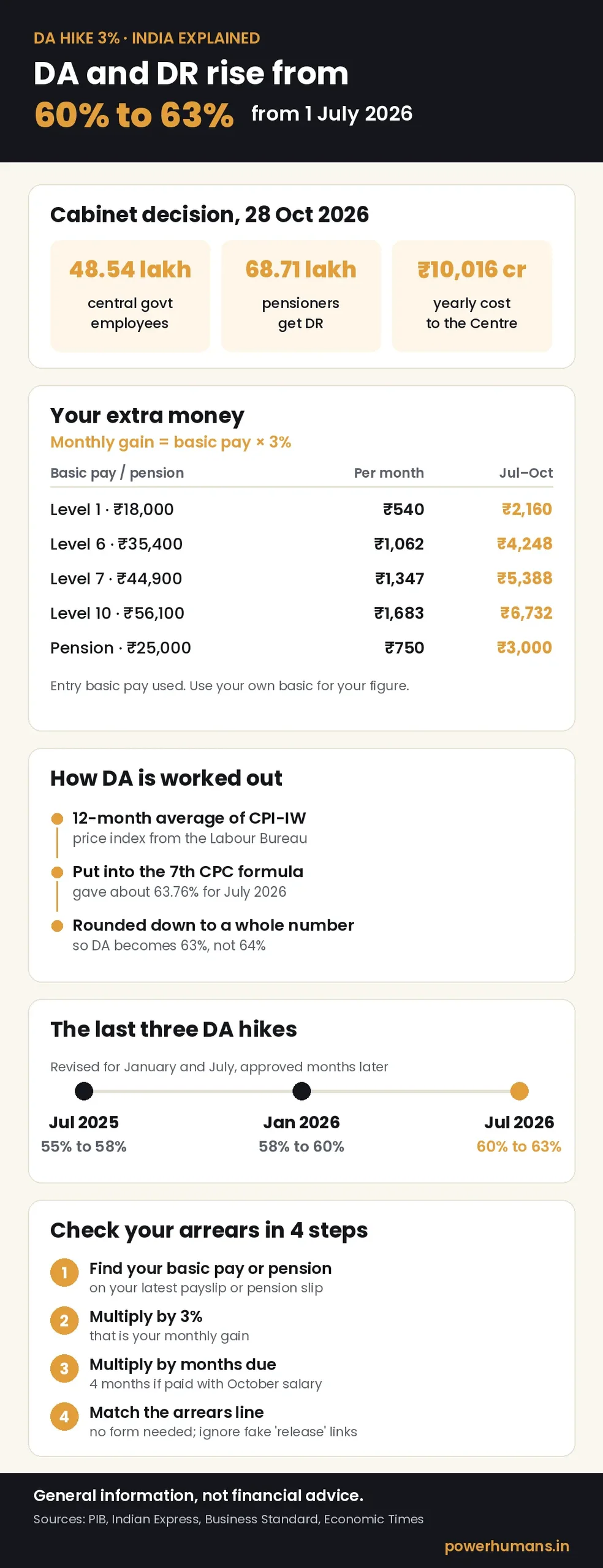
If you’re a central government employee or pensioner, your Diwali just got a little brighter. On 28 October 2026 the Union Cabinet approved a DA hike of 3 percent, taking dearness allowance (DA) and dearness relief (DR) from 60% to 63% of basic pay and pension, backdated to 1 July 2026.
But “3%” doesn’t mean your salary rises by 3%. It’s 3% of your basic pay, and the real number in your bank account, plus the arrears, depends on your pay level. Here’s how to work out exactly what you’ll get, and when.
Quick answer
- Mehngai bhatta kitna badha? By 3 percentage points: DA and DR go from 60% to 63%.
- From when? With effect from 1 July 2026, so the months since July are paid as arrears.
- Who gets it? About 48.54 lakh central government employees and 68.71 lakh pensioners, as per the government’s statement.
- How much more? 3% of your basic pay or basic pension each month. On the lowest basic pay of ₹18,000, that’s ₹540 a month.
- State employees? Not automatically. Each state decides its own DA.
DA hike 3 percent: what the Cabinet approved on 28 October
The Press Information Bureau release, posted at 3:51 PM on Wednesday, says the Cabinet approved an “additional instalment” of DA for central government employees and DR for pensioners, effective 1 July 2026. It is a 3% increase over the existing rate of 60% of basic pay or pension, meant to compensate for rising prices.
Three numbers from the official statement are worth remembering:
- ₹10,016.10 crore a year is the combined cost of the DA and DR increase to the government.
- 48.54 lakh serving central government employees benefit.
- 68.71 lakh pensioners benefit, so over 1.17 crore people in total.
Information and Broadcasting Minister Ashwini Vaishnaw, announcing the decision, called it a Diwali gift for employees and pensioners, The Times of India reported. The government says the rise follows the accepted formula based on the 7th Central Pay Commission’s recommendations. It’s the second revision this year: in April, the Cabinet raised DA by 2 points to 60% for the January 2026 instalment. For more stories like this, see our India Explained series.
3% DA hike means what, exactly?
A common confusion: the hike is in percentage points of basic pay, not 3% of your total salary. If your basic pay is ₹18,000, your DA was 60% of that (₹10,800) and becomes 63% (₹11,340). The difference, ₹540, is your monthly gain. Your HRA and other allowances don’t change because of this decision.
DA hike calculator: how much your salary rises
You can do the maths in under a minute. Use this simple formula:
Monthly gain = Basic pay × 3 ÷ 100
Here’s what that looks like at the starting basic pay of common 7th CPC pay levels. The last column is the total extra money for July to October (four months), which is what several reports expect to arrive with the October salary.
| Pay level (entry basic pay) | DA at 63% | Extra per month | Extra for Jul–Oct |
|---|---|---|---|
| Level 1 (₹18,000) | ₹11,340 | ₹540 | ₹2,160 |
| Level 4 (₹25,500) | ₹16,065 | ₹765 | ₹3,060 |
| Level 6 (₹35,400) | ₹22,302 | ₹1,062 | ₹4,248 |
| Level 7 (₹44,900) | ₹28,287 | ₹1,347 | ₹5,388 |
| Level 10 (₹56,100) | ₹35,343 | ₹1,683 | ₹6,732 |
| Level 13 (₹1,23,100) | ₹77,553 | ₹3,693 | ₹14,772 |
Your actual basic pay is probably higher than the entry figure if you’ve had annual increments or promotions, so plug your own number into the formula. Arrears are worked out month by month on the basic you actually drew, so an increment in July, a promotion or leave without pay will change the total.
DA arrears July 2026: when will the money come?
DA arrear kab milega? The Cabinet approval is the big step, but the money moves only after the Department of Expenditure issues an office memorandum and your pay office or bank processes it. There’s nothing to apply for: arrears are credited automatically.
Since the new rate counts from 1 July 2026, you’re owed the difference for every month since then. Gujarati dailies such as Gujarat Samachar and GSTV reported that employees are expected to get four months of arrears (July to October) with the October salary, ahead of Diwali. Business Standard notes that beneficiaries are eligible for arrears for the intervening period, and that the payout could support festive spending. If your department pays a little later, you still get the full amount, just in a later month.
How to check your DA arrears in 4 steps
- Find your basic pay on your latest payslip (or basic pension on your pension slip).
- Multiply by 3% to get the monthly gain.
- Multiply by the months due: four if the October salary also carries the new rate, more if payment slips to November.
- Match it on the payslip: look for a separate “DA arrears” line. If it’s missing two months after the order, ask your DDO (drawing and disbursing officer) or pension disbursing bank.
Dearness relief for pensioners: what changes
Pensioners get the same 3-point rise as dearness relief (DR). The formula is the same: 3% of your basic pension. On the 7th CPC minimum pension of ₹9,000, DR rises by ₹270 a month (₹1,080 for July to October). On a basic pension of ₹25,000, it rises by ₹750 a month, taking total DR to ₹15,750.
Family pensioners also receive DR on their family pension. If you’ve commuted part of your pension, ask your bank how DR is applied to your pension, because rules on commutation can affect the base. DR is credited by your pension disbursing bank, so check your passbook or bank statement rather than waiting for a separate letter.

How DA is calculated (and why it’s 63%, not 64%)
DA isn’t picked at random. It tracks inflation through the All India Consumer Price Index for Industrial Workers (CPI-IW), which the Labour Bureau releases every month. Under the 7th CPC formula, the government takes the 12-month average of this index and compares it with a fixed base level. The Economic Times explained that the 12-month average to June 2026 worked out to a DA of about 63.76%. Because DA is fixed in whole numbers, it was rounded down to 63%.
That’s why the hike was widely expected long before the announcement. The revision happens twice a year, for January and July, but the decision usually comes a few months later. The Indian Express notes the last three instalments:
- July 2025: 55% to 58% (approved 1 October 2025)
- January 2026: 58% to 60% (approved 18 April 2026)
- July 2026: 60% to 63% (approved 28 October 2026)
Is DA taxable? What else the hike changes
Yes. DA is fully taxable as part of your salary, and DR is taxable along with your pension. Since the arrears for July to October fall in the same financial year (2026-27), they simply add to this year’s taxable income. A few other knock-on effects:
- NPS or UPS contributions rise. Contributions are calculated on basic pay plus DA, so your monthly deduction, and the government’s share, go up slightly too.
- Check your TDS. A bigger salary in October may mean a little more tax deducted. If you’re close to a slab change, review your investment declarations with your office.
- No change to HRA. This decision raises DA and DR only.
Tax rules depend on your income and chosen regime, so check with a chartered accountant if your situation is complicated.
DA hike for state government employees, PSU and bank staff
This decision covers central government employees and central pensioners only. State government employees get DA from their own state government, which announces it separately and often with a gap. Employees of central PSUs on the industrial DA pattern, and bank employees, have their own DA systems that are revised on a different schedule, so this order doesn’t apply to them. Private-sector employees get DA only if their employer’s pay structure includes it.
8th Pay Commission latest news: will DA reset?
The 8th Central Pay Commission was set up by a government notification on 3 November 2025 and has 18 months to report, which puts the deadline around May 2027. It is chaired by former Supreme Court judge Justice Ranjana Prakash Desai and is still consulting unions and employee groups, Mint reports.
Until its recommendations are accepted and implemented, DA continues under the 7th CPC formula, which is why this hike happened at all. The next instalment, for January 2027, will again depend on CPI-IW data. Any new pay matrix, fitment factor or change in how DA works will come only after the Commission reports and the government decides, so treat social media “confirmed” numbers with caution.
What to do with your DA arrears: 5 smart moves
- Verify, then spend. Check the arrears line on your payslip before Diwali shopping.
- Split the lump sum. Use some for the festival and park the rest in an emergency fund or recurring deposit. Our tips on saving money on groceries help the monthly gain go further too.
- Buy gold with eyes open. If festive gold is on your list, read the hidden costs of jewellery, digital gold and ETFs first, and note how sharply silver prices have swung this month.
- Invest with the tax rules in mind. Putting the arrears into equity funds? Understand how LTCG tax works on shares and mutual funds.
- Don’t fall for fake “DA arrears” links. Arrears come automatically. No one needs your bank OTP or a fee to “release” them.
More money explainers are on our Business page, and the latest big stories are on Trending.
This article is general information, not financial or tax advice. Your exact DA, arrears and tax depend on your pay level, service record and official orders. Check with your office, pension bank or a qualified tax professional.
FAQ
DA kitna percent hai abhi?
After the 28 October 2026 decision, DA for central government employees is 63% of basic pay, and DR for pensioners is 63% of basic pension, with effect from 1 July 2026.
DA arrear kab milega?
Arrears are paid automatically once the office memorandum is issued and processed. Reports expect the July to October amount with the October salary, but some offices may pay it a month later.
How much will my salary increase with the 3% DA hike?
By 3% of your basic pay each month. For example, ₹540 on a basic of ₹18,000 and ₹1,347 on ₹44,900.
Is the DA hike for state government employees too?
No. This decision is for central government employees and pensioners. State governments announce their own DA rates.
How is DA calculated for central government employees?
Using the 12-month average of the CPI-IW index released by the Labour Bureau, under the 7th Pay Commission formula. The result is rounded down to a whole number.
Is DA taxable?
Yes. DA is taxed as part of your salary and DR as part of your pension, in the year you receive it.
The takeaway
The DA hike of 3 percent is small on paper but real in your account: 3% of your basic pay every month, plus arrears from July. Take two minutes to calculate your figure, check it on your payslip, and give the lump sum a plan before the Diwali sales do it for you.
Related reads
- LTCG tax cut news: how the 12.5% tax on shares and mutual funds works
- Buying gold this festive season? The hidden costs explained
- Why silver price is falling, and should you buy silver now?
Sources
- PIB: Cabinet approves Dearness Allowance to Central Government employees and Dearness Relief to Pensioners (28 Oct 2026)
- Business Standard: Govt hikes DA, DR to 63% from 60% (28 Oct 2026)
- The Indian Express: DA hike, how is DA calculated (28 Oct 2026)
- The Times of India: Cabinet approves 3% DA increase for central govt employees (28 Oct 2026)
- Gujarat Samachar: DA hike, arrears with October salary (28 Oct 2026, Gujarati)
- The Economic Times: Why employees expected a 63% DA (CPI-IW calculation)
- 8th Central Pay Commission: About Us (official website)
- Mint: 8th Pay Commission, top 10 updates (28 Oct 2026)





Leave a Reply