

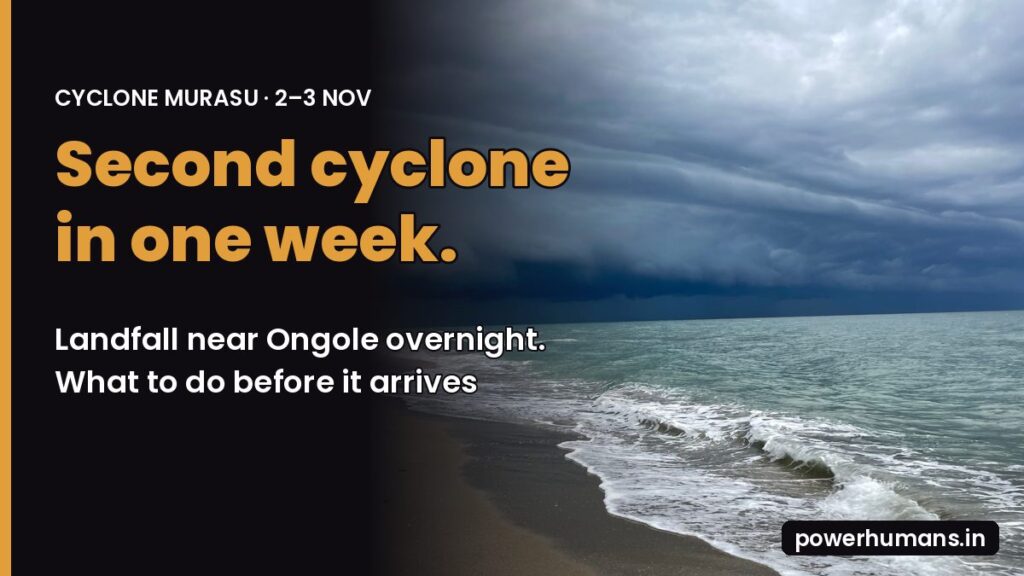
Andhra Pradesh had barely cleared the fallen trees left by Cyclone Arnab when the India Meteorological Department (IMD) named the next one. Cyclone Murasu strengthened into a severe cyclonic storm early on Monday, 2 November, and is set to cross the south Andhra coast near Ongole between 11:30 pm tonight and 4 am on Tuesday.
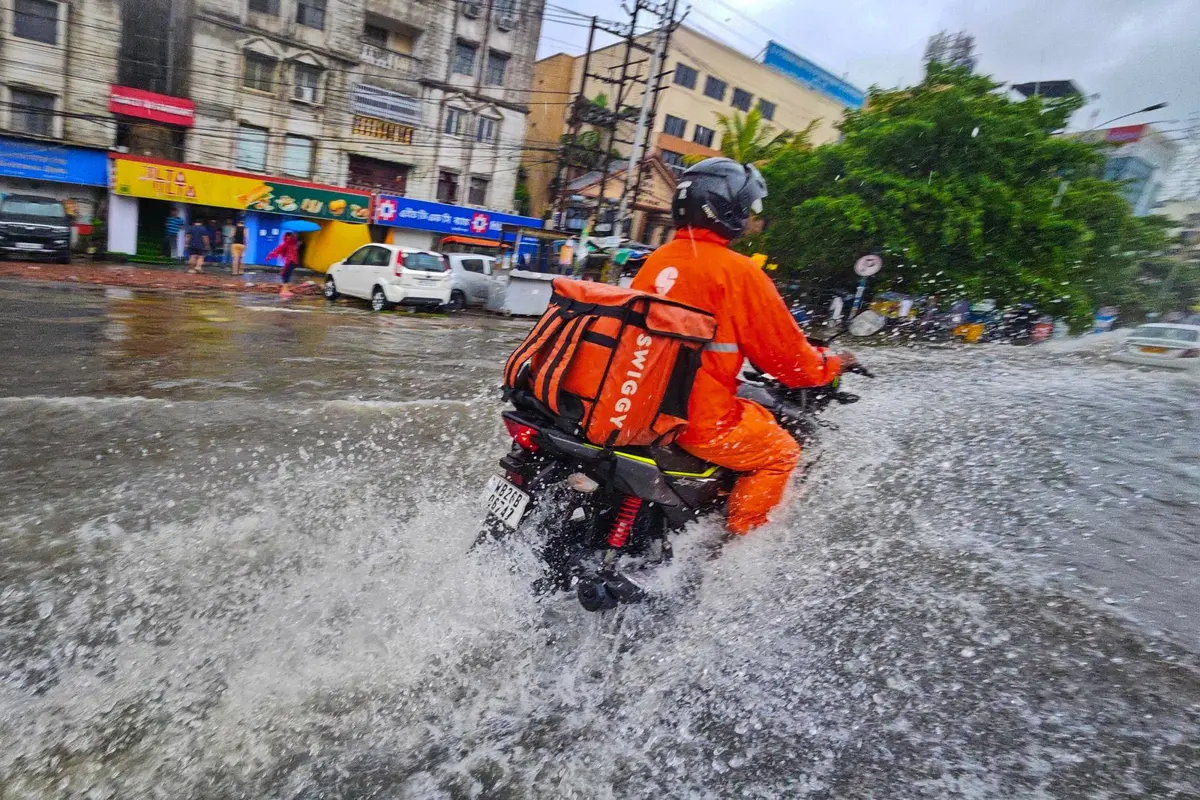
Chennai is already feeling its outer rain bands, and schools there are shut for the day. Here’s where Murasu will hit, what “severe” really means, why the Bay of Bengal throws up back-to-back storms every November, and a short checklist for landfall night.
Quick answer
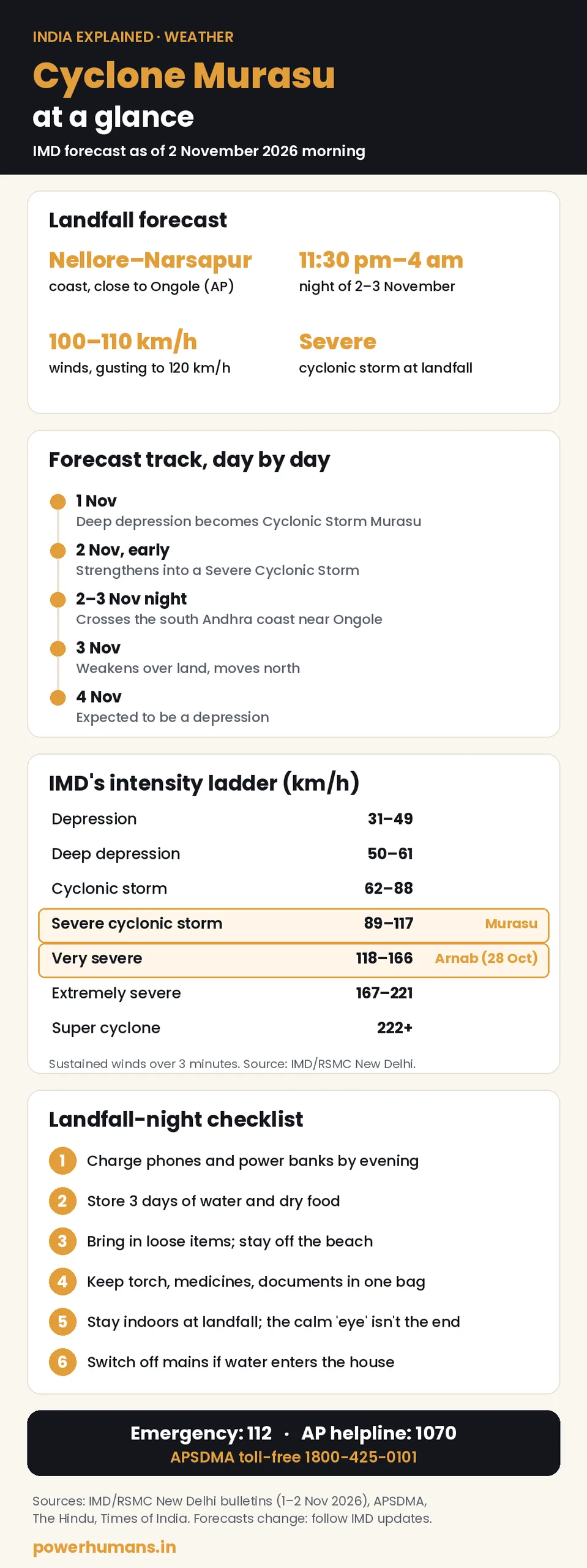
- Landfall: between Nellore and Narsapur, close to Ongole (Andhra Pradesh), from about 11:30 pm on 2 November to 4 am on 3 November.
- Strength: a severe cyclonic storm, with sustained winds of 100–110 km/h gusting to 120 km/h.
- Red alert (Monday): extremely heavy rain likely in Krishna, Guntur, Bapatla, Prakasam and Nellore districts.
- Chennai: orange alert for very heavy rain (12–20 cm in 24 hours) in Chennai and Tiruvallur; schools and colleges closed on 2 November.
- Helplines (AP): 112 for emergencies, 1070 and 1800-425-0101 for disaster help.
Figures are from IMD bulletins and official statements up to the morning of 2 November 2026. Cyclone forecasts change every few hours, so check the latest IMD update before you travel.
Cyclone Murasu landfall: where, when and how strong
Murasu began as a deep depression over the southwest Bay of Bengal and became a cyclonic storm on Sunday, 1 November. By 5:30 pm that evening it was about 420 km east-southeast of Chennai and 530 km southeast of Ongole, moving west-northwest at around 25 km/h.
In the early hours of Monday it intensified into a severe cyclonic storm. At 2:30 am it lay about 290 km east-southeast of Nellore and 330 km southeast of Ongole, according to the IMD observation reported by The Hindu.
IMD’s forecast for the Cyclone Murasu landfall time is the night of 2–3 November, between 11:30 pm and 4 am. The landfall place is the stretch between Nellore and Narsapur, close to Ongole in Prakasam district. Winds at landfall are expected at 100–110 km/h, gusting to 120 km/h.
Murasu is the second cyclonic storm to hit Andhra Pradesh in less than a week. The first, Cyclone Arnab, crossed the coast on 28 October as a very severe cyclonic storm, a category stronger than Murasu is forecast to be.
What happens after landfall?
A cyclone loses strength once it moves over land, because it’s cut off from the warm sea water that fuels it. IMD’s track forecast from 1 November shows Murasu weakening to a cyclonic storm by Tuesday morning, a deep depression by Tuesday night and a depression by Wednesday morning, as it moves north over Telangana.
Weakening doesn’t mean the rain stops. Heavy rain often continues inland for a day or two after landfall, which is why IMD has red alerts for some districts on Tuesday as well.
Cyclone Murasu affected areas: district-wise alerts
Andhra Pradesh
For Monday, IMD has a red alert for extremely heavy rain in Krishna, Guntur, Bapatla, Prakasam and Nellore. An orange alert covers East Godavari, West Godavari, Eluru, NTR, Palnadu, Tirupati and Chittoor, and a yellow alert covers Alluri Sitharama Raju (ASR), Kakinada, Konaseema, Nandyal, Kadapa and Annamayya.
For Tuesday, the red alert shifts to ASR, Eluru and NTR, with orange alerts for Chittoor, Annamayya, Tirupati, Nellore, Prakasam, Palnadu and Vizianagaram, as reported by The Times of India.
The state has stationed six National Disaster Response Force (NDRF) teams and seven State Disaster Response Force (SDRF) teams in the districts likely to be hit, with two teams each in Krishna, Bapatla, Guntur, Nellore and Prakasam. NTR and Guntur districts have declared a holiday for schools and colleges on Monday.
Cyclone Murasu and Chennai
Murasu won’t make landfall in Tamil Nadu, but its rain bands are already over the north of the state. The Regional Meteorological Centre has an orange alert for Chennai and Tiruvallur on Monday, warning of very heavy rain of 12–20 cm in 24 hours. Chengalpattu, Kancheepuram, Ranipet, Vellore and the Nilgiris are on yellow alert.
The Chennai and Tiruvallur collectors declared a holiday for schools on 2 November, and the University of Madras postponed the day’s exams. If you’re searching for “school holiday tomorrow”, the Chennai notice was “for one day only”, so watch the collector’s official X handle for any extension. Rain is expected to ease in Chennai from Tuesday, though thunderstorms may continue at isolated places until 5 November.
What “severe cyclonic storm” means, in plain numbers
IMD sorts storms by their maximum sustained wind, averaged over three minutes. A storm only gets a name once it reaches cyclonic-storm strength, 62 km/h or more.
- Depression: 31–49 km/h
- Deep depression: 50–61 km/h
- Cyclonic storm: 62–88 km/h
- Severe cyclonic storm: 89–117 km/h (Murasu’s forecast category at landfall)
- Very severe cyclonic storm: 118–166 km/h (Arnab’s category)
- Extremely severe cyclonic storm: 167–221 km/h
- Super cyclonic storm: 222 km/h and above
So what’s the difference between a cyclone and a super cyclone? Mainly wind speed: a super cyclone blows more than twice as hard as a minimal cyclonic storm. But a “severe” storm can still uproot trees, snap power lines and damage kutcha houses, and in a storm like this one the heaviest damage often comes from rain and flooding rather than wind.
Why two cyclones in one week? November is peak season
Back-to-back storms feel unusual, but the calendar explains a lot. IMD’s cyclone FAQ says cyclones over the north Indian Ocean peak twice a year: a primary peak in November and a smaller one in May. October–November is also when storms of severe intensity are most likely.
Three things line up at this time of year:
- A warm sea. Cyclones need ocean water of at least 26.5°C to a good depth. The Bay of Bengal is still warm after the summer.
- The northeast monsoon. From October to December, easterly winds push storms that form over the Bay towards the Tamil Nadu and Andhra coasts.
- The Bay itself. The Bay of Bengal sees about four cyclones for every one in the Arabian Sea. On average the north Indian Ocean gets about five cyclones a year.
Andhra Pradesh is especially exposed. IMD notes that the state sees the most severe cyclonic storms of any Indian coastal state, while Odisha gets the most cyclones overall.
Cyclone Murasu named by which country? The meaning of Murasu
India gave the name. Murasu is Tamil for a drum, an ancient instrument once beaten to pass on news and warn people of danger. It’s one of 13 names India contributed to the list of 169 names adopted in April 2020 by 13 countries of the WMO/ESCAP Panel on Tropical Cyclones.
Names are used in order, and none is ever reused. Arnab came from Bangladesh and sat just before Murasu on the list. The next storm over the north Indian Ocean will be called Akvan, a name suggested by Iran.
How to prepare for Cyclone Murasu tonight
If you followed our full cyclone preparation checklist for Arnab, you’re most of the way there. A second storm in a week brings a few extra risks: soaked ground loosens tree roots and old walls, drains are already full, and power lines may still be under repair. Focus on these steps before dark.
- Charge everything by evening. Phones, power banks and emergency lights. Power is often switched off as a precaution during landfall.
- Store water and dry food. Keep enough drinking water and ready-to-eat food for at least three days, plus any regular medicines.
- Pack one go-bag. Torch, medicines, a basic first-aid kit, some cash and copies of ID and key documents in a waterproof pouch.
- Secure loose items. Bring in pots, tin sheets and anything on terraces that strong winds could turn into missiles.
- Stay off the beach and away from the sea. Fishermen have been told not to go out to sea off the Andhra and north Tamil Nadu coasts.
- Follow evacuation orders. If you live in a low-lying coastal area or a kutcha house and officials ask you to move to a relief shelter, go early, in daylight.
- Stay indoors through landfall. If the wind suddenly drops, you may be in the calm “eye” of the storm. Winds return from the other direction, so don’t step out.

After the storm passes
- Don’t walk or drive through floodwater. It can hide open drains, and fallen power lines can make it live.
- Stay away from damaged buildings, leaning trees and snapped cables. Report them to your local authority.
- Drink boiled or purified water until supply is confirmed safe.
- Empty water collected in buckets, tyres and pots within a week. Standing water after heavy rain is where the dengue mosquito breeds, so know the dengue symptoms and warning signs if anyone gets a high fever.
Floods aren’t only a coastal problem. Last week a glacial lake burst in Bhutan and put Bengal and Assam on alert, and the same basic go-bag and flood-safety rules apply there too.
Cyclone Murasu tracker: how to follow live updates
Many sites call themselves a “Cyclone Murasu tracker live”, but only IMD issues official cyclone warnings for India. Use these:
- IMD (mausam.imd.gov.in) and RSMC New Delhi: bulletins every few hours with the storm’s position, track and warnings.
- APSDMA: Andhra Pradesh’s disaster authority shares district alerts. For complaints during the storm you can also use the Mana Mitra WhatsApp service on 95523 00009.
- Your district collector’s official X handle: the fastest source for school holiday notices and evacuation orders.
- NDMA’s SACHET alerts: location-based warnings that are also pushed to mobile phones.
Ignore forwarded maps and voice notes that claim a new landfall point. If it isn’t on an IMD bulletin, don’t act on it.
Bank branches in parts of Andhra and Tamil Nadu may also be hit by local closures this week, on top of the festival holidays. Check the bank holidays in November 2026 before planning a branch visit, and use UPI or net banking where you can.
FAQ
When will Cyclone Murasu make landfall?
IMD expects it to cross the south Andhra Pradesh coast between 11:30 pm on 2 November and about 4 am on 3 November 2026.
Where will Cyclone Murasu hit?
Between Nellore and Narsapur, close to Ongole. Krishna, Guntur, Bapatla, Prakasam and Nellore districts are on red alert for extremely heavy rain on Monday.
Will Cyclone Murasu hit Chennai?
No, landfall is in Andhra Pradesh. But Chennai and Tiruvallur are on orange alert for very heavy rain on 2 November, and schools there are closed for the day.
What does Murasu mean, and which country named it?
Murasu is a Tamil word for a drum once used to spread news and warnings. India contributed the name to the shared list for the north Indian Ocean.
How many days does a cyclone last?
It varies. Murasu formed on 1 November and IMD expects it to weaken to a depression by 4 November, so about three to four days as a named storm and in its weakening stages. Rain can continue for a day or two after that.
Cyclone Murasu kab aayega aur kitna khatarnak hai?
Landfall is expected on the night of 2–3 November near Ongole as a severe cyclonic storm, with winds of 100–110 km/h. That’s one step below Cyclone Arnab, but heavy rain and flooding are the bigger risk.
The takeaway
Cyclone Murasu is weaker than Arnab, but it’s arriving on ground that’s already soaked, at night, in a state still repairing last week’s damage. That’s what makes it worth taking seriously. Charge your phones, keep water and medicines ready, stay indoors through the night and follow only IMD and your district administration. For more explainers on the news that affects your daily life, browse our India Explained section, the latest weather alerts and what’s trending in India.
Related reads
- Cyclone Arnab: red alerts explained and how to prepare
- Glacial lake outburst flood explained: why a lake in Bhutan put Bengal and Assam on alert
- Dengue symptoms day by day: the warning signs to watch
Sources
- IMD/RSMC New Delhi: Deep depression intensifies into Cyclonic Storm Murasu, with forecast track (1 Nov 2026)
- IMD: All India weather summary and forecast bulletin (1 Nov 2026)
- IMD/RSMC New Delhi: Frequently asked questions on tropical cyclones
- The Hindu: Cyclonic storm Murasu to make landfall close to Ongole (2 Nov 2026)
- The Hindu: Murasu strengthens into Severe Cyclonic Storm (2 Nov 2026)
- The Times of India: Red alert for five districts on the Andhra coast (2 Nov 2026)
- The Hindu: Holiday for schools and colleges in Chennai and Tiruvallur (2 Nov 2026)
- NDTV Profit: Chennai orange alert and school holiday notice
- The Hindu BusinessLine: Very severe cyclone Arnab crosses Andhra coast (28 Oct 2026)
- IMD: New list of names of tropical cyclones over the north Indian Ocean (April 2020)
- APSDMA: Cyclone information and helplines
- WMO: New list of names issued for tropical cyclones over the north Indian Ocean






Leave a Reply