


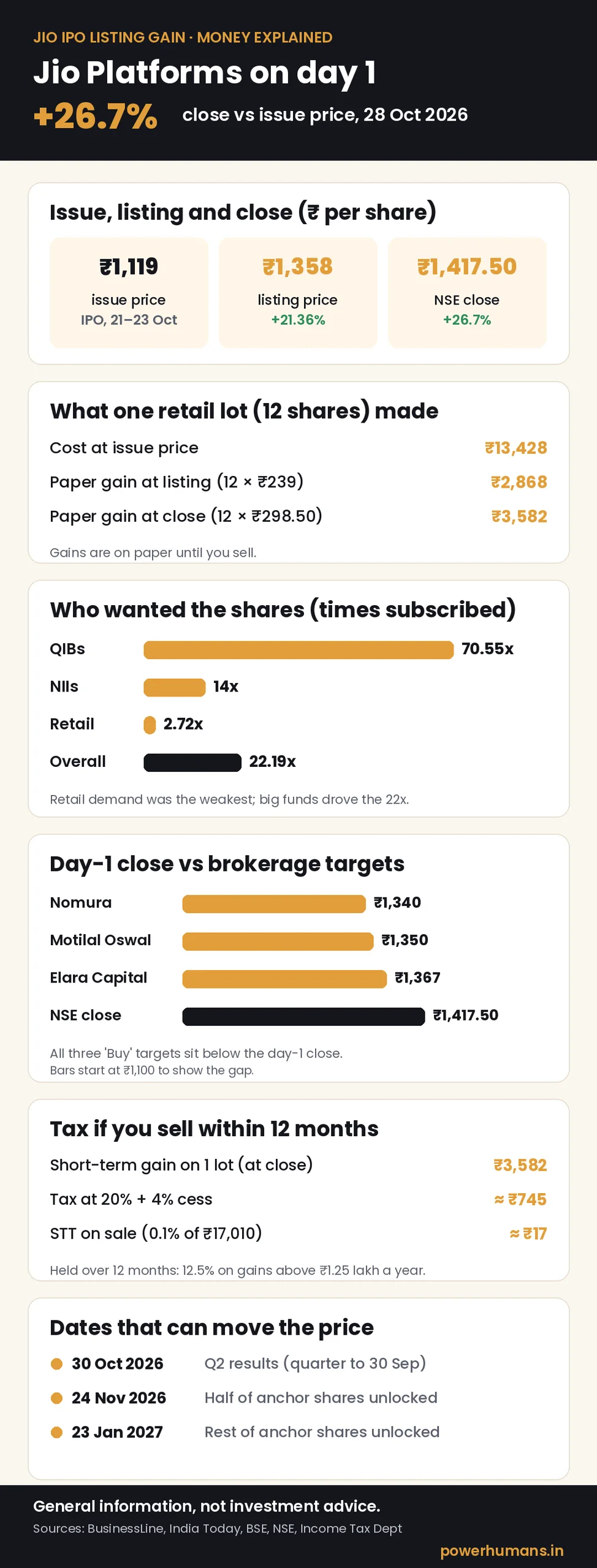
Jio Platforms, India’s biggest-ever IPO, ended its first day of trading 26.7% above the issue price. That’s a quick ₹3,582 on paper for anyone who got one retail lot. But here’s the twist: the stock closed above the price targets of all three brokerages that rated it “Buy” that same morning.
So is the Jio IPO listing gain money you should lock in, or the start of a longer ride? Below are the real numbers, the tax you’d pay if you sell, the dates that could move the price, and a simple plan for each type of investor.
Quick answer
- Jio IPO listing price: ₹1,358 on NSE and BSE on 28 October 2026, 21.36% above the ₹1,119 issue price.
- Day-1 close: ₹1,417.50 on NSE (up about 26.7%). One lot of 12 shares was up ₹3,582 on paper.
- Tax if you sell within 12 months: 20% short-term capital gains tax plus 4% cess, so roughly ₹745 on that one-lot gain.
- Sell or hold? It depends on why you applied. Short-term flippers have their gain; long-term holders should watch the Q2 results on 30 October and the anchor lock-in expiry on 24 November.
- Didn’t get shares? Don’t chase the first-day jump. You’d be buying above every published brokerage target.
Jio IPO listing gain: what happened on day 1
The ₹30,213-crore issue opened on 21 October and closed on 23 October. It was priced at the top of the ₹1,065–1,119 band, with a retail lot of 12 shares (₹13,428 at the issue price). Allotment was finalised on 26 October, and the shares listed at 10 am on 28 October.
Here’s what the numbers looked like, as reported by The Hindu BusinessLine and India Today:
- Listing: ₹1,358 on both exchanges, a gain of ₹239 per share (21.36%).
- Close: ₹1,417.50 on NSE and ₹1,417.35 on BSE, close to the day’s high.
- Value: about ₹12.5 lakh crore at listing, making Jio India’s second most valuable listed company after its parent, Reliance Industries.
- Demand: 22.19 times subscribed overall. Big institutions (QIBs) bid 70.55 times their quota and non-institutional investors 14 times, but the retail portion was subscribed only about 2.7 times.
That last point matters. The rush came mostly from large funds. Retail demand was healthy but not wild, which is why many small investors who applied with one lot actually got shares.
What is listing gain in an IPO?
A listing gain is the difference between the price you paid in the IPO and the price at which the stock starts trading. It’s only a paper gain until you sell. If you hold on, your real profit or loss depends on the price on the day you finally sell, not on listing day.

Should I sell Jio IPO shares or hold? Start with these 3 facts
Search “should I sell Jio IPO or hold” and you’ll find confident answers both ways. Nobody knows tomorrow’s price. What you can do is look at the facts that are already on the table.
1. The price is already above the brokerage targets
On listing day, three brokerages started coverage with “Buy” ratings, India Today reported: Nomura (target ₹1,340), Motilal Oswal (₹1,350) and Elara Capital (₹1,367). These were bullish calls on the business, but every one of those targets is below the ₹1,417.50 close. In plain words, the market has already priced in what these analysts expected, at least for now. Targets can be raised later, so treat this as a reason for caution, not a sell signal.
2. Very few shares are actually trading
Reliance Industries still holds 64.48% of Jio Platforms, and Motilal Oswal pointed out that the free float is under 3%. India Today put the free-float market value at about ₹27,236 crore, a small slice of the ₹12.5 lakh crore total. When so few shares trade, prices can swing sharply in both directions on modest buying or selling.
3. More shares will become free to sell soon
Anchor investors bought about 7.25 crore shares before the IPO opened. SEBI rules lock these in for a while after allotment. According to Jio’s lock-in details filed with BSE, about 3.62 crore anchor shares are locked in until 24 November 2026 and the other 3.62 crore until 23 January 2027. Once a lock-in ends, some anchors may sell. That doesn’t always push the price down, but it often adds volatility around those dates. A BusinessLine-quoted analyst also flagged pre-IPO investor lock-ins ending in April 2027.
Income tax on IPO listing gain: what you’ll pay if you sell
Selling within 12 months of allotment makes your profit a short-term capital gain. For listed shares on which securities transaction tax (STT) is paid, the Income Tax Department taxes this at a flat 20% (it was 15% for sales before 23 July 2024), plus 4% health and education cess.
Here’s a worked example for one lot, using the day-1 close:
- Sale value: 12 × ₹1,417.50 = ₹17,010
- Gain: ₹17,010 − ₹13,428 = ₹3,582
- Tax: 20% of ₹3,582 = ₹716.40, plus 4% cess ≈ ₹745
- STT: 0.1% of the sale value ≈ ₹17, cut automatically when you sell. Brokerage and depository charges depend on your broker.
Two things many first-time investors miss. First, if your total income without this gain is below the basic exemption limit, a resident individual can use the unused limit against the short-term gain, under the same tax rules. Second, if you hold for more than 12 months, the gain becomes long-term and is taxed at 12.5% only on gains above ₹1.25 lakh a year. Our explainer on how LTCG tax on shares works and what may change covers that in detail.
Report the gain in your income tax return for the year you sell (FY 2026-27 if you sell before 31 March 2027). Your broker’s capital gains statement will show the figures.
Jio share sell or hold: a plan for each type of investor
Instead of asking “Jio share buy or sell?”, ask why you bought in the first place. Here’s how to think about it:
You applied for a quick listing gain
You already have what you came for. Some investors in this spot sell part of their holding, say enough to take back their original ₹13,428, and let the rest ride. That way, a later fall can’t turn the trade into a loss, and you still benefit if the stock keeps rising.
You want to own Jio for years
Then the daily price matters less than the business. Brokerages are betting on tariff hikes (Nomura expects a possible 15% industry-wide hike in November–December 2026), home broadband growth and lower spending now that most 5G investment is done. Track what analysts told BusinessLine to watch: average revenue per user (ARPU), subscriber additions, churn, broadband growth and debt. The first test comes with the Jio Platforms Q2 results on Friday, 30 October.
You didn’t get an allotment and want to buy now
The IPO discount is gone. At ₹1,400-plus, you’d pay more than every published target. If you still want Jio, consider buying in small parts over a few months rather than all at once, and keep any single stock to a modest share of your savings. Big, popular listings can cool off after the excitement fades.
Jio share kaise kharide: how to buy or sell step by step
- Check the Jio IPO allotment status. If you applied, look up your PAN or application number on the registrar KFin Technologies’ website, or on the BSE or NSE IPO status pages. “Allotment” simply means whether you were given shares.
- Confirm the credit. Allotted shares appear in your demat account (check your broker app or the CDSL/NSDL statement). If you weren’t allotted, the blocked money in your bank account (ASBA) should be released.
- Find the right stock. Search for Jio Platforms in your broker app. It trades as JPL on NSE and code 545004 on BSE. Don’t confuse it with Jio Financial Services, a different listed company.
- Use a limit order. For a new stock that moves fast, set the price you’re willing to buy or sell at rather than placing a market order.
- Keep your contract note. You’ll need it for your tax return.
Never share your demat PIN or OTP with anyone offering “guaranteed” Jio tips on WhatsApp or Telegram. Exchanges and brokers don’t sell stock tips in chat groups.
Jio share price target: why to treat it with care
A target is one analyst’s estimate of fair value, usually over 12 months, based on assumptions about tariffs, subscribers and costs. Targets are revised often, sometimes right after a big move. Use them to understand the reasoning, not as a promise. For a broader picture of how tech and telecom fit into India’s AI build-out, see our story on L&T’s ₹15,000 crore NVIDIA AI factory deal.
If your gains are part of a bigger money plan this festive season, think about the whole picture. Central government staff getting arrears can check how much the 3% DA hike adds to salary and pension, and if you’re tempted by commodities, read why silver prices have swung so sharply. More guides live in our Personal Finance section and on the Business page, and today’s biggest stories are on Trending.
This article is general information, not investment or tax advice. Share prices change every minute, and the figures here are as of the 28 October 2026 close. Talk to a SEBI-registered investment adviser or a chartered accountant before acting on your own situation.
FAQ
What was the Jio IPO listing price?
Jio Platforms listed at ₹1,358 on NSE and BSE on 28 October 2026, a 21.36% premium over the ₹1,119 issue price. It closed the day at ₹1,417.50 on NSE.
Should I sell Jio IPO shares or hold?
It depends on your goal. If you applied for a quick gain, booking all or part of it is reasonable. If you want to own Jio for years, focus on its quarterly results, ARPU and debt rather than daily moves. The stock closed above all three brokerage targets on day 1, so expect volatility.
Is IPO listing gain taxable?
Yes, but only when you sell. If you sell within 12 months, the gain is taxed as short-term capital gain at 20% plus cess. On one Jio lot sold at ₹1,417.50, that’s about ₹745.
How do I check my Jio IPO allotment status?
Enter your PAN or application number on the registrar KFin Technologies’ website or on the BSE or NSE IPO allotment pages. Allotted shares show up in your demat account.
Jio share kaise kharide if I didn’t get the IPO?
You can buy Jio Platforms shares on NSE (symbol JPL) or BSE (code 545004) through any broker with a demat account. Use a limit order and avoid buying everything in one go after a sharp rise.
When are the Jio Platforms Q2 results?
Reliance said Jio Platforms will announce its results for the September quarter (Q2 FY27) on Friday, 30 October 2026.
The takeaway
The Jio IPO listing gain was real, but it’s still only on paper for anyone holding. Decide why you own the stock, work out the tax before you sell, and mark three dates on your calendar: 30 October, 24 November and 23 January. A plan you set today will serve you better than a hot tip tomorrow.
Related reads
- LTCG tax cut news: how the 12.5% tax on shares and mutual funds works
- DA hike 3 percent: how much your salary and pension will rise
- Why silver price is falling, and should you buy silver now?
Sources
- The Hindu BusinessLine: Jio Platforms ends with 27% listing gains (28 Oct 2026)
- India Today: Jio Platforms share price live, brokerages initiate coverage with Buy ratings (28 Oct 2026)
- The Indian Express: Jio debuts at a premium of 21% after ₹30,213 crore issue (28 Oct 2026)
- BSE: Jio Platforms Limited lock-in details
- Upstox News: Jio Platforms to announce Q2 results on October 30
- Income Tax Department: Section 111A, tax on short-term capital gains (20% from 23 July 2024)
- NSE: STT and other levies
- Mint: SEBI anchor investor lock-in rules







Leave a Reply