

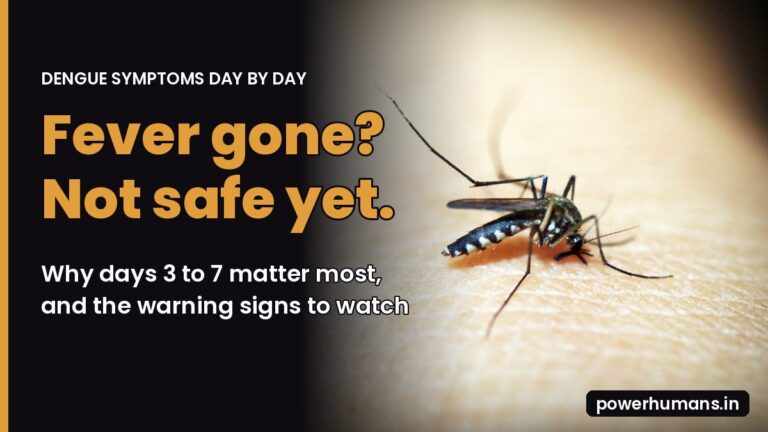
Most families relax when the thermometer finally drops below 100°F. But track dengue symptoms day by day and you’ll see the trap: the serious complications usually show up around the time the fever breaks, not at its peak.
This guide walks through each phase, from the first sudden fever to the risky “critical phase” and recovery. It also covers which test to ask for on which day, what platelet numbers actually mean, what to eat, and the warning signs that mean you should go to a hospital today, not tomorrow.
Quick answer
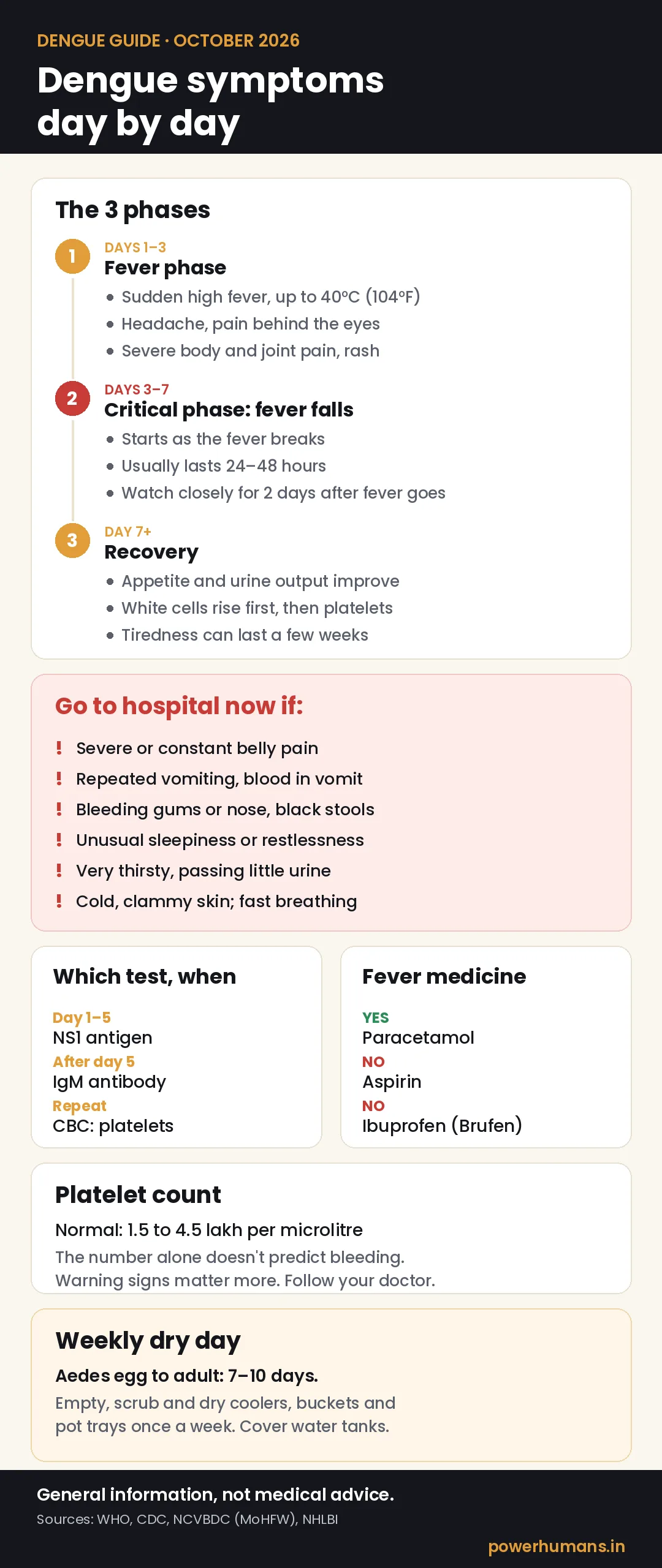
- Days 1–3: sudden high fever (up to 40°C/104°F), severe headache, pain behind the eyes, body and joint pain, nausea, sometimes a rash.
- Days 3–7, when the fever falls: the critical phase. It typically lasts 24–48 hours. Watch for belly pain, repeated vomiting, bleeding gums or nose, extreme tiredness or restlessness.
- Test: NS1 antigen in the first 5 days; IgM antibody after day 5.
- Medicine: paracetamol only for fever and pain. Avoid aspirin and ibuprofen (Brufen).
- Go to hospital now if any warning sign appears, even if the fever has gone.
Why dengue is in the news again this week
Dengue peaks after the monsoon. According to the Municipal Corporation of Delhi’s weekly report, reported by PTI on 27 October, Delhi logged 396 dengue cases in October up to 24 October, already more than the 377 cases recorded in the whole of October 2025. The year’s total reached 993, including 92 cases in the week ending 24 October, with no dengue deaths reported so far.
That’s why searches like “dengue ke lakshan” and “dengue platelet count” jump every October. For more seasonal health guides, see our Health & Fitness section.
Dengue symptoms day by day: what to expect
The World Health Organization (WHO) says most people infected with dengue have mild or no symptoms and recover in one to two weeks. When symptoms do appear, they usually begin 4–10 days after the mosquito bite and last 2–7 days. The US Centers for Disease Control and Prevention (CDC) describes three phases: febrile, critical and recovery.
Days 1–3: the febrile phase (dengue ke lakshan)
- Sudden high fever, which can reach 40°C (104°F). The CDC notes the fever can come in two waves.
- Severe headache and pain behind the eyes, a classic dengue clue.
- Muscle and joint pain so intense that dengue was nicknamed “break-bone fever”.
- Nausea, vomiting, swollen glands and a rash. Some people have a flushed face in the first 24–48 hours.
- Minor bleeding signs such as small red skin spots can appear.
Days 3–7: the critical phase, when the fever breaks
This is the part most people don’t know about. The CDC says the critical phase begins when the fever comes down and typically lasts 24–48 hours. Most patients improve, but in a small number, fluid leaks out of blood vessels and the illness can turn into severe dengue within hours. India’s National Center for Vector Borne Diseases Control (NCVBDC) says complications usually appear between the third and fifth day of illness, and advises watching the patient for two more days even after the fever disappears.
The CDC estimates about 1 in 20 people who fall ill progress to severe dengue, and that with early hospital care the risk of death from severe dengue can fall below 0.5%.

Day 7 onwards: recovery
The white blood cell count usually rises first, then platelets. Appetite and urine output improve, and an itchy rash may appear and peel. WHO notes tiredness can last several weeks, so ease back in; our guide to self-care in a busy world has ideas for easing back in.
Dengue warning signs: go to hospital if you see these
The NCVBDC and WHO list these signs. Any one of them, especially as the fever is falling, needs a doctor the same day:
- Severe or constant abdominal pain
- Repeated vomiting, or blood in vomit
- Bleeding from the nose or gums, black stools, or red spots spreading on the skin
- Unusual sleepiness, restlessness or confusion (in children, constant crying)
- Excessive thirst, a very dry mouth, or passing very little urine
- Pale, cold or clammy skin
- Fast or difficult breathing
India’s 2023 national guidelines add that children under 10, adults over 65, pregnant women, and people with obesity, diabetes, high blood pressure or heart, kidney, liver or lung disease face higher risk. They should see a doctor early.
Dengue test: which one, and on which day?
Dengue, viral fever, malaria and chikungunya look alike at first; only a blood test tells them apart. India’s 2023 guidelines recommend:
- NS1 antigen test for samples taken from day 1 to day 5 of fever.
- IgM antibody test (ELISA) after day 5. IgM usually shows up by day 5, though in some people it appears as early as day 2 to 4 or as late as day 7 to 8.
- Complete blood count (CBC), repeated as advised. Falling platelets with rising haematocrit (thicker blood) is an early sign of worsening.
Dengue platelet count: what’s the danger level?
A normal adult platelet count is 1.5 lakh to 4.5 lakh per microlitre (150,000–450,000), according to the US National Heart, Lung, and Blood Institute. In dengue, it commonly drops, sometimes sharply, during days 3–7.
Here’s what surprises many families: the platelet number alone is not the danger signal. India’s 2023 national guidelines say platelet counts are unreliable for predicting bleeding. They cite a trial in adults with counts of 20,000 or below and no significant bleeding, where preventive platelet transfusions did not prevent bleeding better than normal care and caused more side effects. The guidelines reserve platelet transfusions mainly for patients with significant bleeding, decided by the treating doctors.
So don’t panic over one report or rush to arrange donors unless the doctor asks. Keep testing as advised and watch the warning signs. NCVBDC lists a platelet count above 50,000, plus 24 hours without fever and good appetite, among its hospital discharge criteria.
Can dengue be treated at home? What helps and what to avoid
There is no specific medicine for dengue. Mild dengue without warning signs is usually managed at home with regular check-ups. NCVBDC’s advice:
- Use paracetamol for fever and body pain, in the dose your doctor prescribes, and not more than four times in 24 hours.
- Do not take aspirin, ibuprofen (Brufen) or similar painkillers. WHO warns these NSAIDs can increase the risk of bleeding. This is the answer to “dengue paracetamol or ibuprofen”: paracetamol only.
- Drink plenty of fluids: water, soups, milk, juice. ORS or coconut water also help you keep up.
- Take complete rest.
- Don’t self-start antibiotics or steroids. National guidelines for doctors say antibiotics are not to be used for dengue and steroids show no benefit.
- Keep the patient under a mosquito net. WHO says mosquitoes can pick up the virus from an infected person from about 2 days before symptoms until 2 days after the fever ends, and then infect others in the house.
Dengue me kya khana chahiye: what to eat in dengue
No food is proven to raise platelets overnight. Aim to keep fluids and calories up:
- Soft, easy-to-digest meals such as khichdi, dal, dalia, idli or curd rice
- Soups, buttermilk, coconut water, fresh fruit and fruit juices
- Protein from dal, curd, milk, paneer or eggs, if they suit you
What about papaya leaf juice? A 2019 systematic review of nine trials (six of them from India) found low-quality evidence that papaya leaf extract may raise platelet counts slightly and shorten hospital stays by about two days. But the authors said the evidence was too weak to recommend routine use. Tell your doctor if you take it, and never let it replace tests or hospital care.
Fasting for a festival this week? Fluids come first when you’re unwell; our Karwa Chauth fasting tips explain when to stop a fast and drink water.
How to prevent dengue at home: the weekly dry-day rule
The Aedes mosquito that spreads dengue bites mainly during the day and breeds almost entirely in clean water stored in and around homes. The CDC says an Aedes egg can turn into an adult mosquito in 7–10 days, so emptying water once a week breaks the cycle.
- Keep one dry day every week, as NCVBDC recommends: empty, scrub and dry coolers, buckets, flower-pot trays, pet bowls and money-plant bottles.
- Scrub, don’t just pour out. Aedes eggs stick to container walls and can survive drying for more than a year, hatching once water returns.
- Cover water tanks and drums with tight lids, and throw away old tyres, coconut shells and disposable cups lying outside.
- Protect yourself in daytime with full sleeves, repellent and nets, especially for napping children.
After storms like Cyclone Arnab, clear stagnant water around your home within a week. In north India, October also brings smoky air; here are smog-season habits that protect your lungs.
FAQ
What are dengue symptoms day by day?
Days 1–3: high fever, headache, eye and body pain. Days 3–7: the fever falls and a 24–48 hour critical phase follows, when warning signs may appear. Then recovery.
Dengue platelet count danger level kya hai?
Normal is 1.5 to 4.5 lakh. Counts often fall in days 3–7, but India’s guidelines say the number alone doesn’t predict bleeding well; warning signs matter more.
What does dengue NS1 positive mean?
Dengue virus protein was found in your blood, pointing to a current infection. NS1 works best in the first five days.
How to increase platelets in dengue?
Platelets usually recover on their own after the critical phase. Rest, fluids and good food help; papaya leaf has only weak evidence.
Can dengue happen twice?
Yes. There are four dengue virus types, and immunity covers only the one you had. WHO says a second infection carries a higher risk of severe dengue.
What is the dengue recovery time?
Most people recover in one to two weeks (WHO), though tiredness can linger for weeks.
The takeaway
Dengue is usually mild, but the risky days often come just as the fever breaks. Track the day of illness, test at the right time, use only paracetamol, keep fluids up, watch the warning signs and empty standing water weekly. Share this with anyone nursing a fever this month, and find more in Lifestyle and Trending.
This article is for general information and isn’t medical advice. If you or a family member has a fever, please consult a doctor, especially for children, older adults, pregnant women and anyone with a long-term illness.
Related reads
- Why Your Throat Burns Every October: 9 Smog-Season Habits That Actually Protect Your Lungs
- Cyclone Arnab Landfall on 28 October: Where It Will Hit, What Red Alerts Mean and How to Prepare
- The Ultimate Guide to Self-Care in a Busy World
Sources
- WHO: Dengue and severe dengue (fact sheet)
- CDC: Clinical features of dengue
- NCVBDC (MoHFW): National Guidelines for Clinical Management of Dengue Fever, 2023
- NCVBDC (MoHFW): Do’s and don’ts for managing dengue
- CDC: Life cycle of Aedes mosquitoes
- NHLBI: Thrombocytopenia (normal platelet count)
- BMC Complementary and Alternative Medicine (2019): Carica papaya extract in dengue, a systematic review and meta-analysis
- The Pioneer/PTI (27 Oct 2026): Delhi dengue and malaria cases, MCD weekly report
- Amar Ujala (27 Oct 2026): 396 dengue cases in October in Delhi




Leave a Reply